Welcome...

There are so many variables that go into making a PIZZA. The hydration of the dough, flour, yeast and many more.. Amounts of any kind of yeast in a pizza can make a big difference. Most recipes posted on the web, use too much yeast in their recipes. What I have found out so far, is either bulk fermenting the dough or cold fermenting the dough will give a better flavor in the crust. I am still experimenting to find different flavors in the crust of pies. In my opinion pizza is all about the best flavor you can achieve in a crust. I still am on the journey about flavors in the crust. Even differences in temperatures in you home or times of the year can influence how much yeast to use. If you want a pizza to develop flavors in the crust, there are many ways to go about achieving this.

Pizzas

Pizzas
Preferment for Lehmann Dough Pizzas

Crust of Pizza

Crust of Pizza
Rim of Preferment Lehmann Formula

Adventure in Pizza Making

There are many ways to go about trying to make any kind of pizzas you want to create. PIZZA making is fun and also you get to eat your finished product. I learned to make all my pizza on http://www.pizzamaking.com/forum/index.php If you look on pizzamaking.com you can see all the beautiful creations of pizzas members make on this site. Members and moderators help members and guests achieve almost any kind of pizzas they want to create. Since joining this site, my pizza making skills have gone from non-existent to something much better. I invite you to take a look at this site.

Total Pageviews

Sicilian Pizza

Sicilian Pizza
Sicilian Pizza with Preferment for Lehmann Dough

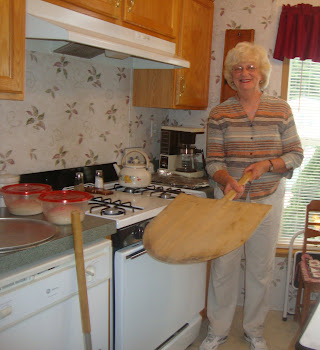
At my mom's home getting ready to bake in her gas oven

At my mom's home getting ready to bake in her gas oven
click on picture to go to post

Sunday, February 6, 2011

Generic Chicago Thin Crust 11/17/2011 V&N (clone attempt)

Attempt at market with pictures for a V&N clone pizza, with formula.

I made another dough ball this morning using the 12" formula  set-forth.  I used my Kitchen Aid professional HD to mix the dough.  I also used whole milk in the formula.  The dough was sticky when finished, but I have since reballed the dough two times. It feels drier now, but probably will get sticky, like my last dough did.  I will take another picture or pictures of how this dough looks during today.  I am going to try and use my home oven to make this pizza.  I will wait until I think the dough looks ready, or might even refrigerate it again and wait until tomorrow, all depending on how this dough ferments at ambient room temperatures of 74 degrees F.  I am going to go to market today to pick up my docker, dark perforated pan, and big rolling pin.  I will see how this pizza turns out in my home setting with my oven.

Peter (Pete-zza) set-forth the formula

I have presented below two V&N clone dough formulations as mentioned in the preceding post. In coming up with these formulations, the only option I had with the expanded dough calculating tool at

http://www.pizzamaking.com/expanded_calculator.html

was to use the Thickness Factor option. If I knew how much water V&N uses to make its full dough batch with 37.5 pounds of flour, I would have been able to add up all of the numbers and use the Dough Weight option.

For the thickness factor, I elected to use 0.08. I would have preferred to use a larger value, possibly 0.09, but with all of the bench flour that is used to get dough balls to a workable stage without sticking to the peel, I decided to use the smaller thickness factor value with the understanding that the finished dough ball weight might be greater than what the expanded dough calculating tool shows. Because of all the estimating and use of bench flour, I also decided not to use a bowl residue compensation. Hopefully, members using the dough formulations will determine the best dough ball weight for each of the two pizza sizes. If that happens, our lives will be made easier on a going forward basis. The dough formulations are simply to give members something to start with and, if they work, to fine tune them or make them even better.

One of the things that will be noted in the two dough formulations is that there really isn’t a lot of milk at the single dough ball level. When one views the V&N video and sees a half-gallon of milk being poured into the mixer bowl, it seems like a lot. But it really isn’t when you consider that there is also 37.5 pounds of flour in the bowl.

As it turns out, when the water in the milk is taken into account in calculating the total water content, including the formula water, the “effective” total hydration is almost 66%. Of course, that value will drop when the bench flour is added to get the dough to a manageable condition.

V&N Clone Dough Formulation for a 12” Pizza
Ceresota Flour (100%):
Water (55%):
IDY (0.283%):
Salt (1.58%):
Milk (fresh) (11.98%):
Total (168.843%):
151.92 g  |  5.36 oz | 0.33 lbs
83.56 g  |  2.95 oz | 0.18 lbs
0.43 g | 0.02 oz | 0 lbs | 0.14 tsp | 0.05 tbsp
2.4 g | 0.08 oz | 0.01 lbs | 0.43 tsp | 0.14 tbsp
18.2 g | 0.64 oz | 0.04 lbs | 3.64 tsp | 1.21 tbsp
256.5 g | 9.05 oz | 0.57 lbs | TF = 0.08
Note: Dough is for a single 12” pizza; thickness factor = 0.08; no bowl residue compensation; the formulation does not reflect the addition of bench flour

V&N Clone Dough Formulation for a 14” Pizza
Ceresota Flour (100%):
Water (55%):
IDY (0.283%):
Salt (1.58%):
Milk (fresh) (11.98%):
Total (168.843%):
206.78 g  |  7.29 oz | 0.46 lbs
113.73 g  |  4.01 oz | 0.25 lbs
0.59 g | 0.02 oz | 0 lbs | 0.19 tsp | 0.06 tbsp
3.27 g | 0.12 oz | 0.01 lbs | 0.59 tsp | 0.2 tbsp
24.77 g | 0.87 oz | 0.05 lbs | 4.95 tsp | 1.65 tbsp
349.13 g | 12.32 oz | 0.77 lbs | TF = 0.08
Note: Dough is for a single 14” pizza; thickness factor = 0.08; no bowl residue compensation: the formulation does not reflect the additions of bench flour

Peter

EDIT (11/18/10): Heckers flour, which is the same as the Ceresota flour and from the same company, can be substituted for the Ceresota flour

Steve and I made two pizzas with the formula Peter set-forth.  The only thing I changed was to use whole milk, because that is all I had yesterday, when I made the dough.  I used Ceresota flour in the formula.  This is the one pizza we made..  Steve and I both thought the V&N clone was excellent.  Even my taste testers thought the pizza was good.  I had the one pie sitting on the counter and I guess people thought they were samples, because my test testers were tasting the pizza.  A few people walking by took some pieces.  One man came back later and wanted to purchase more.  We told him the pie was only an experimental pie.

I wish I could taste a real V&N pizza.  Both of the pizzas we made today were crispy and thin.

This is a video of cutting the pizza.   http://www.youtube.com/watch?v=4GmWzAKyqlw

I think Peter’s formula was great.

Norma


Generic Chicago Thin Crust or V&N clone 11/16/2010

This second pizza was made out of the formula for one 14" pizza.  There was enough left over dough to make another pizza from the one dough.  I just reballed the dough and left it sit out at ambient room temperatures for another couple of 1 ½ hrs.

This one dough that two pizzas were made from was made yesterday and left to sit at ambient room temperatures of 72 degrees F  for 6 hrs.  In that time the dough was reballed two times.  I then put it into the refrigerator overnight because I thought the dough might overferment.  The first dough ball was left out at market today for another 5 hours.  The remainder of the dough, that was left over, was left at ambient room temperatures of around 78 degrees F.

Maybe Steve and I rolled out the dough to thin.  Since I don’t know how much the dough should have been rolled out, we just guessed, because we wanted to have the skin thin.  This dough was sticky, but when floured it did roll out well. The dough for both of these pizzas were docked.  I was trying to think how to go about baking a thin crust pizza and didn’t know whether to use a cutter pan, my perforated dark pan, or something else.  I decided to try the dark perforated pan for the first pie that was made and the first pie was then put on the stone after a while.  The second pie was baked only on the stone, but moved to the top oven after I thought the bottom wasn’t getting finished enough. Both methods seemed to work.

The taste of this crust was very good.  We left one slice cool down for about an 1 ½ hrs.  It then became softer.  We put that slice or part back into the oven and in a short while it became crisp again.

Norma


Generic Chicago Thin Crust 11/17/2011-11/18/2011-Attempt for a V&N Clone

I had some luck with the sticking point of the formula set-forth, as anyone can read below.  Since I really have no idea of how thin this next crust should be, I will roll again and then weigh any extra dough.

At least I was glad this crust did have a good flavor after playing around with the Ultra-thin thread and those crusts having no flavor.  Steve and I talked yesterday about the pizzas we made and I said this almost was like the pizza I tasted at the New York Restaurant and Pizza Expo, except the crust was a little softer on the real Ultra-Thin pizza.  Maybe my memory isn't exactly right, about the real Ultra-Thin pizzas, but the pies were good yesterday.

I made another dough ball this morning using the 12" formula you set-forth.  I used my Kitchen Aid professional HD to mix the dough.  I also used whole milk in the formula.  The dough was sticky when finished, but I have since reballed the dough two times. It feels drier now, but probably will get sticky, like my last dough did.  I will take another picture or pictures of how this dough looks during today.  I am going to try and use my home oven to make this pizza.  I will wait until I think the dough looks ready, or might even refrigerate it again and wait until tomorrow, all depending on how this dough ferments at ambient room temperatures of 74 degrees F.  I am going to go to market today to pick up my docker, dark perforated pan, and big rolling pin.  I saw how this pizza turned out in my home setting with my oven.

Norma


Re: Ideas to use extra dough? 2/26/2010

I use the leftover dough ball today, from the Malnati Deep Dish with Durum Flour that I made February 12, 2010. http://www.pizzamaking.com/forum/index.php/topic,6480.msg90089.html#msg90089


The dough ball was taken out of the freezer late this morning and left to unfreeze. The first picture is of the dough ball frozen. I wanted to try out a rectangular deep-dish pan, so I used that.  The dough was rolled out with a rolling pin.  There weren’t any problems with rolling out the dough.  The dough then was cut 10"x10" to fit in the rectangular pan.  The pie was dressed with a mixture of Brand 1950/127 part skim mozzarella Foremost Brand, Bella Francesca whole milk mozzarella, and State Brand white cheddar.  The sauce used was 6 in 1 seasoned with salt and sugar.  After the pie was baked I put fresh basil on to finish.

I found this Malnati Deep Dish recipe with the Durum Flour very tasty. I really like how easy this dough is to handle.  I also like the crisp bottom.  I could eat 4 slices of this pie.

Thanks BTB for the great formula!

Norma


Re: Generic Chicago Thin Crust 11/23/2010 V&N Clone

Peter (Pete-zza) set-forth a new formula to try.

I have set forth below the updated rendition of the V&N clone dough formulation for a 14” pizza based on the analysis of my last post. I used the expanded dough calculating tool at

http://www.pizzamaking.com/expanded_calculator.html


Ceresota or Heckers Flour (100%):
Water (55%):
IDY (0.283%):
Salt (2%):
2% Milk (fresh) (11.98%):
Total (169.263%):
136.65 g  |  4.82 oz | 0.3 lbs
75.16 g  |  2.65 oz | 0.17 lbs
0.39 g | 0.01 oz | 0 lbs | 0.13 tsp | 0.04 tbsp
2.73 g | 0.1 oz | 0.01 lbs | 0.49 tsp | 0.16 tbsp
16.37 g | 0.58 oz | 0.04 lbs | 3.27 tsp | 1.09 tbsp
231.3 g | 8.16 oz | 0.51 lbs | TF = 0.053
Note: Dough is for a single 14” pizza; nominal thickness factor = 0.053; the formulation does not take into account any added bench flour (estimated at around 12% of the weight of formula flour noted above); no bowl residue compensation

Since it is possible that V&N uses two dough ball sizes, despite my speculation, it may become necessary at some point to further revise the above dough formulation to reflect the two sizes. Hopefully, further clarification on this point might come out of any experiments conducted by our knowledgeable members who decide to try the dough formulation.

Of course, it is possible to use the expanded dough calculating tool to come up with a dough formulation for a 12” pizza, should one choose to try that size. All the entries in the tool would be the same in this case except for the pizza size.

Peter

I tried another attempt for a V&N clone.  I mixed the formula Peter set-forth at

http://www.pizzamaking.com/forum/index.php/topic,6368.msg117734.html#msg117734

and left the dough sit out for a total of 17 hrs.  I did reball the dough several times.  This attempt for theV&N clone was made at market today.  This is what the dough balled looked like before I used it to bake into a pizza. The dough ball was rolled with a rolling pin and then opened the rest of the way as I normally open a dough ball.  The dough ball was the right amount for a 14" pizza.

Norma


Malnati Deep Dish with Semolina 2/12/2010

I must say, I thought this Malnati Deep Dish was really good.  One slice was enough to fill me. Thanks to BTB and everyone that has contributed to this style of pizza.

I rolled the dough out for this pie. The dough was easy to roll out.  I made the one spot too thin, so I just patched it with the leftover dough. The Malnati Deep Dish was dressed with mozzarella, sausage, pepperoni, and 6 in 1 sauce and grated Parmesan cheese..  I added only sugar and sea salt to the 6 in 1 sauce.

Since I have only made one other deep dish, I really don’t have too much to compare this to. I do think the Durum flour was okay to use in this pie.  The crust was crispy.

Norma


Peter (Pete-zza) posted about using durum flour:

Since Norma used durum flour for her version of your pizza and posted here, I thought I would post here also on the durum/semolina issue.

I have always viewed durum as being a species of wheat and semolina as the ground endosperm of the durum wheat. Semolina flour is not a distinct species, like whole wheat or rye flour. It comes only from the endosperm of durum wheat. That is consistent with what I have read on Wikipedia about durum wheat, at

http://en.wikipedia.org/wiki/Durum

and on semolina, at

http://en.wikipedia.org/wiki/Semolina


I suppose the fineness of the semolina characterizes it as fine or coarse. Assuming that what Norma used was durum flour, and that the bag was properly labeled, then I believe she would have gotten the endosperm also. No doubt, there is a lot of mislabeling going on with durum and semolina, with little likelihood of anyone being around to clarify what your really have on your hands.

Peter

Norma


Giordanno's Style Thin Crust 3/09/2010

I made a Giordanno’s Style Thin Crust 3/09/2010.  I used a cutter pan, rolled out the dough, docked the dough, and then par-baked the crust before dressing the pie and doing the final bake.
The pie was dressed with 6 in 1 sauce, mozzarella, grated Asiago Cheese, and Parmesan.

Norma